Great
Strong value with minor trade-offs.
At a glance
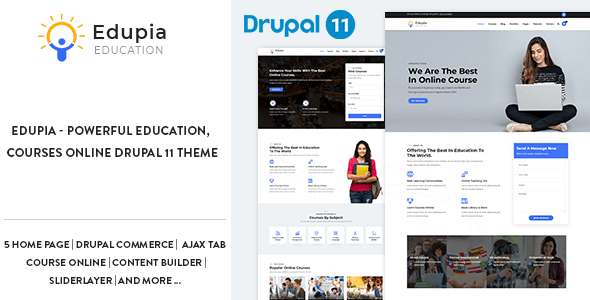
Edupia is a well-scoped Drupal theme for education sites that balances front-end polish, a practical drag-and-drop builder, and Commerce-ready infrastructure at a price most institutions can justify easily. It suits schools, colleges, and independent course creators who want a professional starting point on Drupal 10 or 11 without extensive custom development. Buyers who need deep out-of-the-box LMS functionality or prefer a larger community ecosystem should factor in the additional module work required. For straightforward education and online course sites, Edupia earns a confident recommendation from our editorial team.
Best for
The review
4 min readWhat Is Edupia and Who Is It For?
Edupia is a premium Drupal theme developed by Gavias, a studio with a consistent track record of education-focused CMS products. It targets a clearly defined audience: institutions and individuals building education-related websites — think universities, colleges, K–12 schools, independent tutors, online academies, and course marketplaces modeled loosely on platforms like Udemy or Coursera. If your Drupal project revolves around presenting courses, managing student enrollment, or publishing academic content, Edupia is purpose-built for exactly that.
The theme supports both Drupal 10.x and the current Drupal 11.x, which matters more than it might seem. Staying current with Drupal's major versions is a real commitment for theme authors, and Gavias has met it — the last recorded update was January 2026, signaling active maintenance rather than an abandoned product.
Standout Capabilities
Gavias Block Builder
The centerpiece of Edupia's content workflow is the proprietary Gavias Block Builder, a drag-and-drop layout tool that lets site builders assemble page sections without writing code. For education teams that don't have a dedicated developer on staff, this lowers the barrier to building well-structured course pages, program listings, and landing pages. A library of bundled widgets — counters, testimonials, course grids, instructor profiles, and more — extends what the builder can produce out of the box.
Course and LMS Infrastructure
Edupia ships with front-end structures suited to online learning: course listings, individual lesson pages, and three distinct access tiers (open to everyone, restricted to logged-in users, or gated behind course registration). Paired with PayPal integration and compatibility with Drupal Commerce, the theme supports a basic paid-course workflow without requiring a separate e-commerce overhaul. That combination is relatively rare at this price point in the Drupal theme market.
Bootstrap 4 and Modern Front-End Stack
The theme is built on Bootstrap 4, with SASS, HTML5, CSS3, and Font Awesome 5 rounding out the front-end stack. For developers inheriting or customizing the site, this is a known, documented foundation. Responsive behavior across devices is built in rather than bolted on, which is table stakes in 2025 but still worth confirming given the browser compatibility list spans Chrome, Firefox, Safari, Opera, Edge, and IE11.
Documentation and Onboarding
The author labels documentation as "well documented," which aligns with what buyers typically expect from established Gavias products. Clear documentation meaningfully reduces setup time for teams new to the theme or to Drupal generally.
Pricing and Value Assessment
At $58 for a one-time license, Edupia sits at the affordable end of the premium Drupal theme market. There are no recurring subscription fees attached to the license itself, though buyers should note that extended support beyond the included period typically costs extra on the marketplace. For an institution or small business, the combination of LMS-oriented layouts, a page builder, and Commerce compatibility at this price represents solid value — comparable solutions built from scratch or assembled from separate modules would cost significantly more in developer time.
The one caveat: the theme is sold as a front-end theme. More advanced LMS functionality — gradebooks, certificates, deep course analytics — will require additional Drupal modules, some of which carry their own licensing or configuration overhead.
Reading the Sales and Rating History
Edupia has recorded 265 sales and carries a 5.00 out of 5 buyer rating from 7 reviews. The perfect rating across a small review pool is encouraging but should be weighted accordingly — seven reviews is not a large enough sample to draw firm conclusions about long-term support quality or edge-case reliability. The sales figure of 265 suggests a steadily adopted niche product rather than a blockbuster, which is normal for a platform-specific education theme. It also means the community around the theme is smaller than you'd find with a broad WordPress multipurpose product, which can affect how quickly peer-sourced answers appear in forums.
Who Should Look Elsewhere
Edupia is not a general-purpose theme and isn't trying to be. If your Drupal site covers multiple unrelated verticals — corporate, portfolio, and e-commerce simultaneously — a broader multipurpose theme will serve you better. Buyers who need deep LMS features such as quizzes with auto-grading, certificates, or SCORM content out of the box will need to budget for additional module work regardless of which theme they choose, including Edupia. Finally, organizations that have already standardized on a different front-end framework (Tailwind, Bootstrap 5) may find Bootstrap 4's conventions a friction point during customization.
Those running Drupal 9 or older should also be aware that this theme targets Drupal 10 and 11 — moving forward on the theme likely means moving forward on the CMS version as well.
The trade-offs
What works, what to weigh
What works
- Supports both Drupal 10.x and 11.x, reflecting active maintenance from the author as recently as January 2026.
- Purpose-built education layouts — course grids, lesson pages, instructor profiles — reduce custom development time significantly.
- Integrated Gavias Block Builder provides a drag-and-drop editing workflow without requiring third-party page builder modules.
- Drupal Commerce compatibility and PayPal integration enable basic paid-course or product sales without a separate e-commerce theme.
- One-time $58 license offers strong value for the feature set relative to custom Drupal education builds.
- Well-documented theme from an established Drupal studio, lowering the onboarding burden for new site builders.
What to weigh
- Small review pool (7 ratings) makes the perfect 5.00 score statistically thin — long-term support quality is harder to verify.
- Advanced LMS features (quizzes, certificates, SCORM) are not included and require additional Drupal modules and configuration.
- Built on Bootstrap 4, which is a generation behind Bootstrap 5 — teams wanting the latest framework may face minor friction.
- Proprietary Gavias Block Builder creates a degree of vendor lock-in; switching builders later requires significant rework.
- Smaller buyer community (265 sales) means fewer peer-sourced tutorials or community fixes compared to top-tier WordPress equivalents.
Under the hood
Specs & compatibility
Works with
- On the market
- 7 years ago
- Columns
- 4+
- Documentation
- Well Documented
- Files included
- PHP Files, CSS Files, JS Files
Marketplace-listed browser compatibility: IE11, Firefox, Safari, Opera, Chrome, Edge.
Editorial scores are judgements about documented features and marketplace signals, not measured speed or support benchmarks. Marketplace data last checked: 2026-07-08. Read our assessment method.
Questions, answered
Frequently asked
Is Edupia compatible with the latest version of Drupal?
Yes. Edupia supports both Drupal 10.x and Drupal 11.x, and the author last pushed an update in January 2026, which suggests active maintenance. If you are starting a new site today, you can build on either version with confidence. That said, always verify your specific Drupal minor version and contributed module stack against the theme before going live.
Do I need coding skills to build pages with Edupia?
Edupia includes the Gavias Block Builder, a drag-and-drop tool that lets you assemble page layouts without writing code. Bundled widgets cover common education content types like course listings and instructors. Some familiarity with Drupal's admin interface is still helpful, as configuring content types and access levels involves standard Drupal workflows rather than a purely visual experience.
Can Edupia handle paid course sales and e-commerce?
Yes — the theme is listed as compatible with Drupal Commerce and includes PayPal integration as noted in the author's feature set. Course access can be set to registered users, logged-in users, or open to everyone. However, full LMS features such as quizzes, certificates, or progress tracking are not built into the theme itself and would require additional Drupal modules.
What is the one-time license price, and does it cover future updates?
Edupia is priced at a one-time fee of $58, which is a single-site regular license through the marketplace. That purchase includes the updates the author publishes, as reflected by the January 2026 update. Our editorial team cannot speak to the author's long-term update commitment, so factor in that Drupal major-version upgrades may require additional theme work down the road.
How reliable is Edupia based on its sales and ratings?
The theme holds a perfect 5.00 out of 5 rating from 7 verified buyer reviews, with 265 total sales recorded on the marketplace. The review count is modest, so the rating reflects a small but uniformly positive sample rather than a large pool of diverse users. We consider the combination of consistent positive feedback and a three-digit sales figure a reasonable signal of stability for a niche Drupal education theme.
Which browsers and devices does Edupia support?
Edupia uses a responsive layout built on Bootstrap 4, so it adapts to mobile, tablet, and desktop screen sizes. Browser compatibility covers Chrome, Firefox, Safari, Opera, Edge, and IE11. IE11 support is a legacy inclusion; if your audience is exclusively on modern browsers, this is a non-issue, but it does show the author has considered broader compatibility.
Our verdict
Edupia is a well-scoped Drupal theme for education sites that balances front-end polish, a practical drag-and-drop builder, and Commerce-ready infrastructure at a price most institutions can justify easily. It suits schools, colleges, and independent course creators who want a professional starting point on Drupal 10 or 11 without extensive custom development. Buyers who need deep out-of-the-box LMS functionality or prefer a larger community ecosystem should factor in the additional module work required. For straightforward education and online course sites, Edupia earns a confident recommendation from our editorial team.
Topics & features
Keep exploring
About the author
Gavias has been selling on Envato since August 2014 and has accumulated nearly 25,000 total marketplace sales — a strong track record for a specialist Drupal studio. Our editorial team has reviewed 25 of their themes, covering business, education, directory, magazine, and niche industry categories.
- Reviewed by us
- 30 themes
- Avg editorial score
- 8.2/10
- Marketplace sales
- 25K
- Selling since
- 2014
This page contains affiliate links — we may earn a commission if you purchase through them, at no extra cost to you.